Gulab jamun traditional preparation guide refers to a proven, step-by-step method for making soft, evenly soaked gulab jamun at home or in a halwai kitchen. It covers khoya-based dough, gentle frying in pure ghee, and one-string sugar syrup so the spheres stay tender, absorb well, and taste authentically Punjabi.
By The Mithai Maharaja | Last updated: 2026-04-10
At a Glance: Hook, Overview, and Table of Contents
To master gulab jamun fast, focus on three pillars: a supple khoya dough, steady low-to-medium frying, and a balanced one-string syrup. This section gives you a quick map of the process and links to deeper steps, tools, and troubleshooting so your first batch lands soft and royal.
-
What you’ll learn
- How halwai kitchens build melt-in-the-mouth texture
- Khoya vs milk powder methods and when to choose each
- Exact cues for one-string syrup and ideal frying temperature
- Shaping, soaking, and resting for even absorption
- Seasonal and humidity adjustments that matter in Brampton
-
Why this guide is different
- Draws on fifth‑generation halwai practice from Phagwara, Punjab
- Localization for kitchens across the GTA climate and seasons
- Action-first steps with clear pass/fail sensory checks
- Real examples from The Mithai Maharaja’s Brampton kitchen
-
Table of Contents
- What Is Gulab Jamun?
- Why Traditional Preparation Matters
- How the Technique Works (Science)
- Types and Methods
- Step-by-Step: Gulab Jamun Traditional Preparation Guide
- Best Practices and Troubleshooting
- Tools, Ingredients, and Resources
- Case Studies and Real Examples
- Storage, Serving, and Pairings
- FAQ
- Related Articles
- Conclusion and Key Takeaways
Quick Answer
The fastest way to get soft gulab jamun is to use fresh khoya, fry gently in pure ghee around 320–330°F, and soak in warm one-string syrup for 30–45 minutes. In Brampton, The Mithai Maharaja prepares authentic, gift-ready batches daily—ideal if you prefer ordering instead of cooking.
Local Tips
- Tip 1: If you’re visiting near Williams Parkway and Torbram Road, plan a quick stop at our kitchen (Units 6 & 7). Weekends get busy—pre‑order online to skip lines.
- Tip 2: GTA winters can cool syrup fast. Keep syrup covered and warm (not boiling) so gulab jamun absorb evenly during December and January parties.
- Tip 3: For wedding weeks and corporate trays, lock in your mithai assortment and flavors early. Our halwai team can coordinate with your broader menu and plating style.
IMPORTANT: These tips reflect our daily Brampton operations and the realities of cooking and serving mithai across GTA seasons.
What Is Gulab Jamun?
Gulab jamun is a classic Punjabi-Delhi mithai: fried milk-solid (khoya) dough balls soaked in rose-cardamom sugar syrup. Authentic versions use pure desi ghee for slow frying and a balanced one-string syrup for deep absorption, yielding a tender crumb and a glossy, amber finish.
-
Core identity
- Milk-solids (khoya/mawa) form a rich, dense base with milk fat and proteins.
- Slow frying creates a thin, caramelized shell and protects a soft interior.
- Rose- and cardamom-scented syrup completes flavor and texture.
-
Regional roots
- Firmly rooted in North Indian halwai tradition—common at weddings and festivals.
- Punjab and Delhi styles favor pure ghee frying and nuanced, not cloying, sweetness.
-
Where it fits on your table
- Perfect finish after chaats, thalis, and North Indian mains.
- Pairs well with saffron milk, rabri, or a scoop of vanilla ice cream.
At The Mithai Maharaja, our fifth‑generation halwai lineage from Phagwara guides how we choose khoya, balance syrup, and time resting. That combination is why our gulab jamun maintain their signature softness even hours after soaking.
Why Traditional Preparation Matters
Traditional technique keeps gulab jamun soft. Gentle gluten development, low-to-medium frying in pure ghee, and one-string syrup prevent hard shells and under-soaked centers. When you control these variables, your batches stay tender, glossy, and evenly sweet from edge to core.
-
Texture depends on foundations
- Over-kneading can toughen; under-kneading yields cracks. Aim for a soft, crack-free ball.
- Ghee temperature around 320–330°F encourages uniform browning without a dry crust.
-
Syrup defines the finish
- One-string consistency (roughly 220–222°F at sea level) ensures capillary absorption.
- Too thin makes them soggy; too thick blocks absorption and sweetness skews.
-
Consistency for events
- For wedding trays, repeatable softness matters more than speed.
- In our experience, rest times of 30–45 minutes hit the sweet spot for even flavor.
If you’re hosting in Brampton and need guaranteed results, our daily production and small gulab jamun portions make plating and portion control straightforward.
How the Technique Works (Science)
Gulab jamun stays soft when milk proteins and milk fat in khoya form a delicate matrix that resists drying. Slow frying sets this matrix, then warm syrup diffuses inward. Capillary action and osmosis pull syrup to the center without collapsing the crumb.
-
Milk-solids matrix
- Khoya concentrates casein and whey proteins; light kneading aligns structure without toughness.
- Milk fat from khoya and ghee lubricates, creating a custard-like feel after soaking.
-
Controlled Maillard browning
- At ~320–330°F, surface sugars brown steadily; protein-sugar reactions form a thin, flavorful shell.
- Excess heat (>350°F) risks a thick crust that blocks syrup.
-
Syrup kinetics
- One-string syrup (about 30–32° Brix in practice) flows smoothly into pores.
- Warm syrup plus warm jamuns speeds diffusion; cold syrup slows and under-soaks.
We’ve found that keeping both syrup and jamuns warm—never boiling—yields the most even absorption, especially during chilly GTA evenings.
Types and Methods: Khoya, Milk Powder, and Paneer
Khoya delivers traditional richness and the most reliable softness. Milk powder is a practical home shortcut. Paneer adds structure and a slightly firmer bite. Choose based on access to ingredients, time, and the finish you prefer.
-
Khoya (traditional)
- Flavor: deep dairy notes, classic Punjabi profile.
- Texture: pillowy with a custard-like interior after soaking.
- When to use: for weddings, gifting, and purist results.
-
Milk powder (home-friendly)
- Flavor: milky and pleasant; slightly lighter than khoya.
- Texture: soft if handled gently; watch for cracks if dough is dry.
- When to use: quick batches or where khoya is unavailable.
-
Paneer (structured)
- Flavor: fresh dairy; takes on syrup aroma well.
- Texture: a touch firmer; useful in hot buffets to hold shape.
- When to use: long service windows or mixed dessert bars.
| Method | Pros | Watch-outs | Best For |
|---|---|---|---|
| Khoya | Rich flavor, classic softness | Needs fresh khoya; avoid over-kneading | Weddings, gifting, purist taste |
| Milk Powder | Easy to find, quick | Cracks if dough is dry; measure moisture | Home batches, weeknight desserts |
| Paneer | Holds shape longer | Can be firmer; knead until smooth | Buffets, long service windows |
For festival assortments, we often pair classic jamuns with premium add‑ons like saffron strands or pistachio dust to elevate gifting without losing heritage character.
Step-by-Step: Gulab Jamun Traditional Preparation Guide
Make soft gulab jamun by preparing a balanced one-string syrup, forming a supple dough from fresh khoya, frying gently in pure ghee at 320–330°F to a deep amber, then soaking warm pieces in warm syrup for 30–45 minutes. Keep everything warm—not hot—for uniform absorption.
Ingredients (Traditional Khoya Method)
- Khoya (mawa): fresh, finely grated; avoid dry, crumbly blocks.
- Binding: a small amount of refined flour or fine semolina as needed.
- Leavening: a pinch of baking soda for tenderness (optional, halwai-style).
- Fat: pure desi ghee for frying; a teaspoon in dough if needed for suppleness.
- Syrup: sugar + water (1:1 by weight), cardamom, rose water, optional saffron.
1) Make the Syrup (One-String)
- Combine equal weights sugar and water; simmer until a light, single thread forms between thumb and forefinger.
- Target about 220–222°F; add cardamom and rose water off heat. Keep covered and warm.
- Check: Syrup should feel lightly viscous, not sticky like honey.
2) Prepare the Dough
- Gently mix grated khoya with a pinch of soda and just enough binding to hold.
- Drizzle a touch of ghee if the mix feels dry; avoid kneading like bread.
- Rest dough 10–15 minutes under a damp cloth to relax and hydrate.
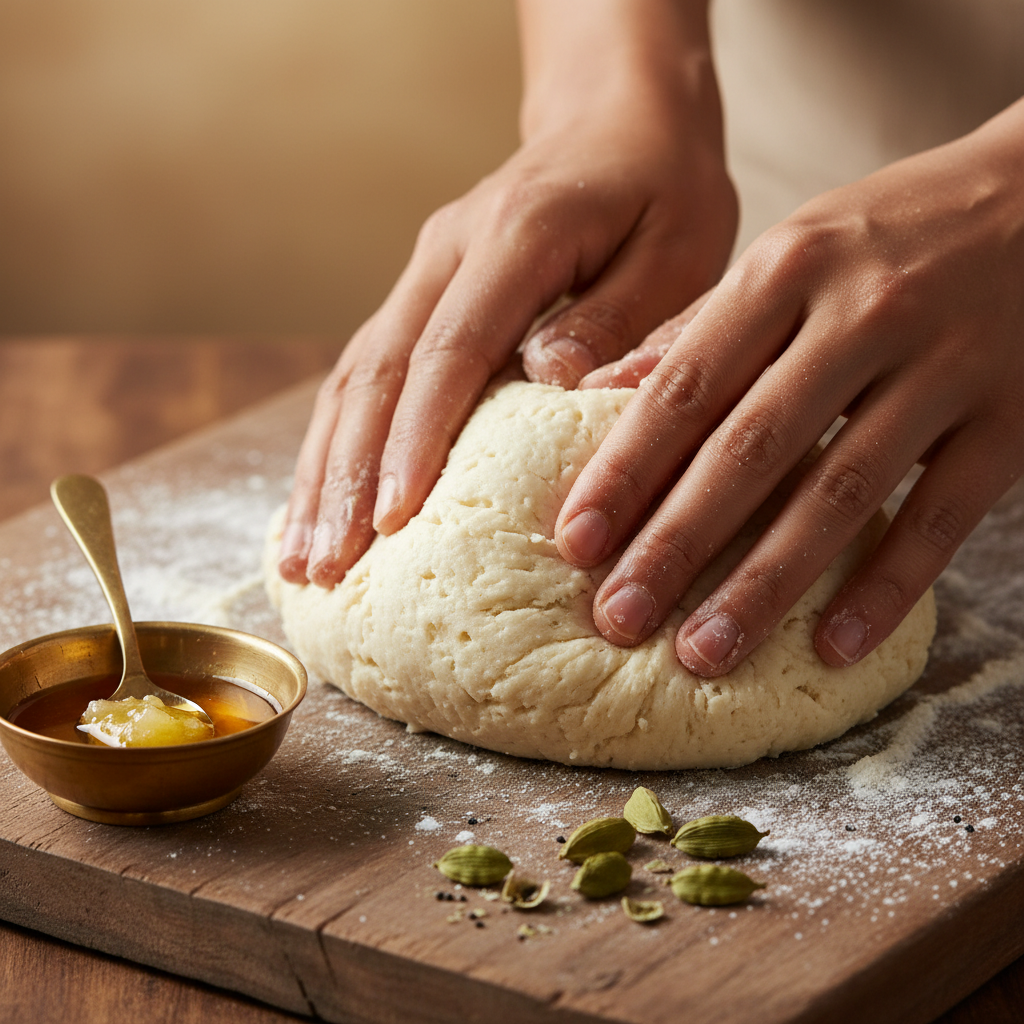
3) Shape Smooth Balls
- Pinch walnut-size portions; roll with light palms until surfaces are glassy-smooth.
- Check: No visible cracks; small fissures expand during frying.
- Optional fillings: a pistachio chip, saffron strand, or tiny mawa cube.
4) Fry Low and Slow in Pure Ghee
- Heat ghee to ~320–330°F. Add a test ball; it should rise slowly and color gradually.
- Fry in batches; stir gently for even coloring. Aim for deep amber, not dark brown.
- Timing: 6–8 minutes per batch depending on size and stove output.
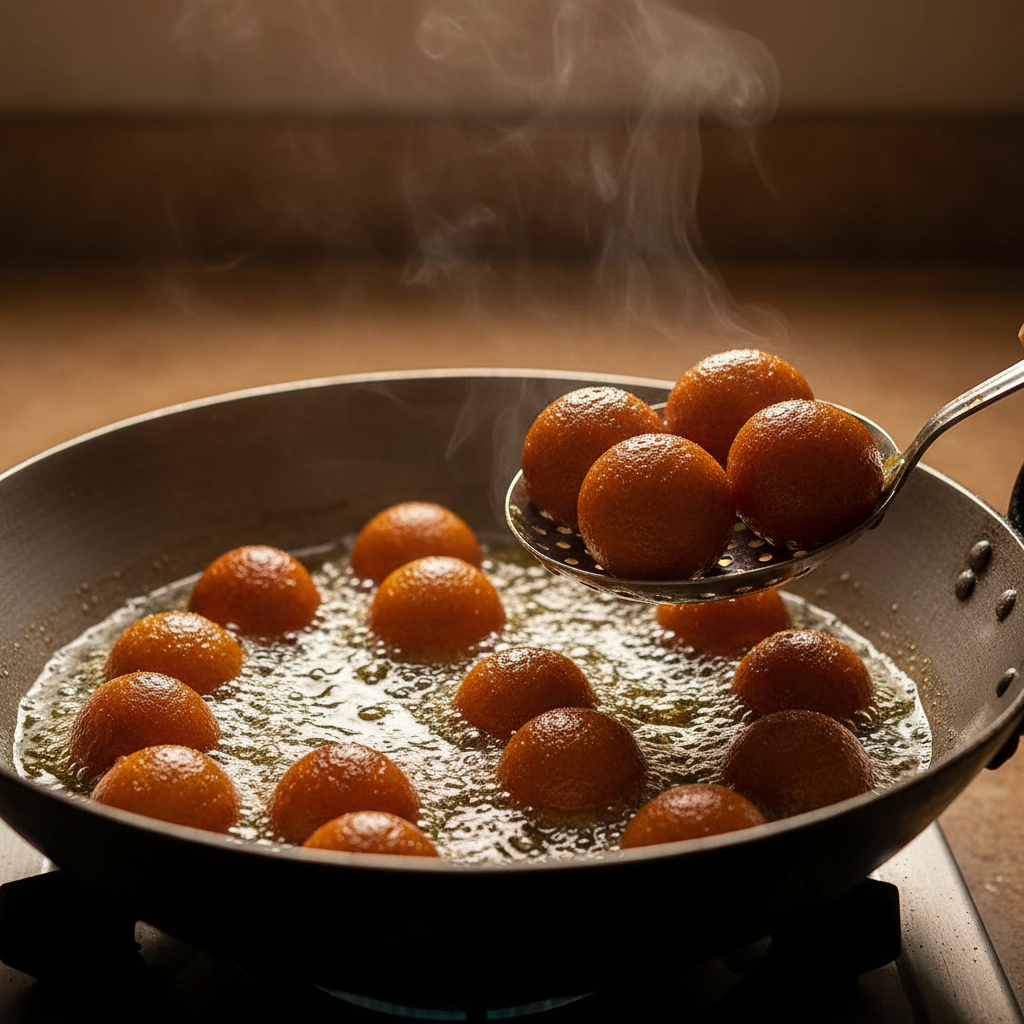
5) Soak While Warm
- Transfer hot jamuns to warm syrup; keep both warm (not boiling) for ideal diffusion.
- Soak 30–45 minutes; rotate gently once or twice for even coverage.
- Check: Press lightly—centers should feel pillowy, not dense.
6) Rest and Serve
- Let jamuns rest another 15–20 minutes; garnish with pistachio slivers or saffron.
- Serve warm for maximum aroma or at room temperature for gift boxes.
- For fast service in Brampton, consider our ready-made gulab jamun alongside your chaats and thalis.
Best Practices and Troubleshooting
Keep dough supple, ghee steady, and syrup at one string. Address cracks before frying, maintain 320–330°F to avoid a hard shell, and soak while both syrup and jamuns are warm. These habits prevent dense centers and ensure even sweetness.
Pro Tips from Our Brampton Halwais
- Moisture is everything: If khoya is dry, mix in a teaspoon of milk or ghee—sparingly.
- Fix tiny cracks fast: Dab with a touch of ghee; re-roll until glossy-smooth.
- Color cues: Light amber signals you can increase heat slightly; deep amber means pull soon.
- Syrup balance: Add a teaspoon of lemon juice during simmer to reduce crystallization.
- Winter service: Keep syrup in an insulated pot; cold syrup under-soaks quickly.
Common Issues and Fixes
-
Dry, hard shell
- Cause: Oil too hot, over-frying.
- Fix: Lower to 320–330°F; shorten fry time slightly.
-
Cracked surfaces
- Cause: Dry dough or over-kneading.
- Fix: Add a few drops of milk or ghee; re-roll gently.
-
Dense centers
- Cause: Too much binding or under-soaking.
- Fix: Reduce flour; extend soak with warm syrup.
-
Soggy texture
- Cause: Syrup too thin or too hot.
- Fix: Return to one-string; let syrup cool slightly before soaking.
Tools, Ingredients, and Resources
Use a heavy kadhai, thermometer, slotted spoon, fine grater for khoya, and an insulated pot for syrup. Quality khoya and pure desi ghee make the biggest difference. A scale and timer keep batches consistent for events and gifting.
Essential Tools
- Heavy kadhai or Dutch oven: Promotes steady heat, prevents scorching.
- Thermometer (clip-on or instant-read): Hold 320–330°F for even browning.
- Slotted spoon and spider: Gentle handling avoids surface damage.
- Digital scale and timer: Consistent sizing and soak timing.
- Insulated syrup pot: Keeps syrup warm during winter services.
Ingredient Quality Signals
- Khoya: Fresh aroma, pale cream color, smooth grate. Avoid sour or chalky blocks.
- Ghee: Clean, buttery scent; no smoky notes.
- Saffron and cardamom: Vibrant color and fragrance; store airtight.
| Process | Target | Pass/Fail Check |
|---|---|---|
| Syrup | One-string (~220–222°F) | Light thread between fingers; lightly viscous |
| Dough | Supple, crack-free | Rolls to a glossy-smooth ball |
| Frying | 320–330°F, deep amber | Rises slowly; colors evenly in 6–8 minutes |
| Soak | 30–45 minutes, warm-warm | Even sweetness edge-to-core |
Planning a banquet? Pair these tools with a simple service plan and labeled trays so staff can portion consistently throughout an event.
Case Studies and Real Examples
Consistency scales when you control size, heat, and soak windows. These quick scenarios show how we adjust dough moisture, batch size, and plating flow in Brampton to deliver soft, glossy jamuns for weddings, weekends, and rainy-day services.
1) Wedding Week: 1,000+ Pieces Over Multiple Days
- Plan: Standardize ball weight and fry color for visual uniformity on trays.
- Execution: Stagger batches; keep syrup warm in insulated pots to maintain one-string feel.
- Result: Even absorption across days; plating remains consistent for photography and service.
2) Rainy Day in the GTA: High Humidity
- Challenge: Khoya absorbs ambient moisture and dough gets tacky.
- Adjustment: Reduce liquid additions; extend dough rest by 5 minutes to stabilize.
- Outcome: Crack-free surfaces and uniform frying even with weather swings.
3) Corporate Platters with Mixed Mithai
- Approach: Use small gulab jamun for tidy portions; pair with kaju and pista notes for color contrast.
- Service Flow: Place syrup-kissed jamuns next to dry sweets like gujia to keep textures distinct.
- Menu Planning: For larger banquets, see halal catering menu planning ideas to coordinate mains and desserts.
Curating a festive gift box? We love tucking in aromatic pieces like Paan Gulkand Roll for a rose-forward complement to jamun’s syrup.
Storage, Serving, and Pairings
Serve gulab jamun warm for peak aroma or room-temp for gifting. Store covered in syrup; rewarm gently without boiling. Pair with rabri, saffron milk, or a scoop of vanilla. For a classic Punjabi duo, serve alongside our house gajar halwa.
-
Storage
- Keep jamuns submerged; exposure dries the crust.
- Rewarm syrup in a water bath; avoid microwave hotspots.
-
Serving windows
- Warm service highlights cardamom and rose aroma.
- Room temperature suits gift boxes and travel.
-
Pairings we love
- Rabri drizzle, pistachio crumble, or saffron milk.
- Contrast with a warm slice of gajar halwa or a cool scoop of ice cream.
FAQ
Soft gulab jamun relies on supple dough, low-to-medium frying in ghee, and one-string syrup. Fix cracks before frying, keep syrup warm, and soak 30–45 minutes. Below are crisp answers to the most common questions we hear in Brampton.
-
How do I know my syrup is at one-string?
Cool a drop between thumb and forefinger, then pull gently—one light thread should form and break. If it’s watery, simmer longer; if sticky like honey, add a splash of hot water and recheck. -
Why are my jamuns cracking during frying?
Tiny surface cracks come from dry dough or over-kneading. Add a few drops of milk or ghee, re-roll until glossy-smooth, and reduce frying temperature slightly to prevent rapid expansion. -
Can I make gulab jamun a day ahead?
Yes. Store submerged in syrup and rewarm gently for service. Warm-warm conditions reactivate absorption and aroma without toughening the shell. -
Which is better—khoya or milk powder?
Khoya is traditional and richer; milk powder is convenient and can be very soft if you manage moisture. Choose khoya for celebrations and milk powder for quick home batches. -
How do I scale for events?
Standardize ball weight, fry color, and soak time. Use insulated pots for syrup and stage batches so warm pieces enter warm syrup. For guaranteed consistency, consider our ready-made gulab jamun.
Related Articles
Explore more in our Guide cluster: traditional Punjabi sweets, festival gift boxes, and street-food pairings that elevate dessert service. Build confidence with structured techniques, then adapt flavors to your family’s style.
- Traditional halwai craftsmanship and why it matters for Punjabi sweets
- Premium mithai selection for wedding gifting (format, flavors, and plating)
- Crispy chaat textures that contrast perfectly with syrupy desserts
- Festival-friendly mithai assortments featuring classics and fusion picks
Want a ready festive accent right now? Our rose-forward Paan Gulkand Roll brings a floral counterpoint to gulab jamun’s syrup.
Conclusion and Key Takeaways
Master softness with a supple khoya dough, low-to-medium ghee frying, and warm one-string syrup. Keep conditions warm-warm for soaking and fix surface issues before frying. With these habits, your jamuns will stay tender, glossy, and celebration-ready.
-
Key Takeaways
- Supple, crack-free dough is non-negotiable for softness.
- Hold 320–330°F in pure ghee; color to deep amber, not dark.
- Use warm one-string syrup; soak 30–45 minutes for even sweetness.
- For events, standardize size, heat, and soak to scale consistency.
- Prefer to order? Our Brampton team prepares authentic batches daily.
-
Next Steps
- Try the khoya method with the checks and tables above.
- Host a tasting: pair jamuns with gajar halwa or rabri.
- For weddings or corporate trays, coordinate flavors and plating with our team.
Final CTA: Planning a celebration in Brampton? Visit The Mithai Maharaja at 2500 Williams Pkwy, Units 6 & 7, or explore our online storefront to reserve your mithai trays and authentic gulab jamun for pickup.