Gulab jamun from scratch is the classic Indian milk-solid dessert shaped into soft spheres, fried low and slow, then soaked in warm cardamom–rose syrup. In Brampton, The Mithai Maharaja prepares these the real halwai way. This guide shows our heritage method step-by-step so you can achieve that melt-in-the-mouth texture at home.
By The Mithai Maharaja • Last updated: 2026-06-09
At a Glance
Mastering gulab jamun from scratch comes down to three controllable variables: dough moisture, frying temperature, and syrup density. Keep oil at 310–325°F, rest the dough 10–15 minutes, and use a 1:1 sugar-to-water syrup by weight flavored with cardamom and rose. Let fried balls soak 20–30 minutes while warm.
Here’s what you’ll learn and why it matters to home cooks and Brampton mithai lovers.
- What gulab jamun is and how the halwai method differs
- Why dough hydration and gentle frying control texture
- Khoya, milk powder, and paneer variants compared
- Exact temperatures, ratios, and timings our halwais use
- Fixes for common issues: cracked shells, dense centers, hard crusts
- Local tips from The Mithai Maharaja kitchen in Brampton
What Is Gulab Jamun?
Gulab jamun is a North Indian dessert made from milk solids (traditionally khoya), shaped into small balls, fried at low heat, and soaked in aromatic sugar syrup. The hallmark is a thin, elastic crust and a custardy interior that absorbs syrup without collapsing, yielding a soft, lush bite.
In our kitchen, “from scratch” means starting with dairy solids, not boxed mixes. Classic halwai shops like ours favor khoya for rich dairy notes and a delicate crumb. Milk powder and paneer approaches are valid, but they require tighter moisture control.
For deeper context on heritage prep, see our internal primer in the traditional preparation guide, where we unpack ingredients and shaping cues our fifth‑generation team uses daily.
Why Making It From Scratch Matters
Cooking gulab jamun from first principles gives you control over texture, aroma, and sweetness. You can fine-tune dough hydration, frying heat, and syrup density to match your preference, from ultra-soft to slightly bouncy, while ensuring clean ingredients and authentic flavor.
Scratch preparation lets you control every variable. You decide syrup sweetness (typically 1:1 sugar-to-water by weight), spice balance (2–3 cardamom pods per cup of syrup), and rose strength (1–2 teaspoons rose water per batch). You’ll also avoid off-flavors from stabilizers often found in premixes.
- Texture control: Adjust liquid by 1–2 teaspoons at a time to correct cracks or soggy centers.
- Flavor integrity: Freshly ground cardamom and saffron bloom best in hot syrup at 185–195°F.
- Dietary choices: Use ghee for frying for a nuttier profile, or neutral oil for a lighter finish.
Once you understand these levers, you can reproduce our halwai-level results in a home pot and confidently serve guests during festivals or family dinners.
How the Method Works: Dough, Fry, and Soak
Perfect gulab jamun relies on balanced dough (milk solids + binder + tenderizer), uniform low-temperature frying, and soaking in warm syrup. Hydrate the dough just enough to form crack-free balls, fry at 310–325°F for 6–8 minutes, then rest 20–30 minutes in 1:1 syrup at 140–160°F.
Think in three stages.
- Dough physics: Milk solids supply protein and milk fat. A small amount of flour binds; a pinch of baking powder creates micro-porosity. Over-kneading tightens gluten and causes tough centers.
- Frying dynamics: At 310–325°F, water in the dough vaporizes slowly, expanding interior pores while the crust browns via Maillard reactions. Too hot (>340°F) and you’ll scorch the shell before interiors set.
- Soaking science: Warm syrup (140–160°F) diffuses into the porous crumb via capillary action. Cold syrup shocks the crust; boiling syrup collapses structure. Keep syrup 5–10°F warmer than room temperature for steady absorption.
For syrup density and troubleshooting, bookmark our in-depth syrup consistency guide with visuals and fix-by-symptom tables.
Types and Methods: Khoya, Milk Powder, Paneer
You can make gulab jamun three reliable ways: with khoya for richness, with milk powder for convenience, or with paneer for a fresh-dairy profile. Each needs slightly different hydration and heat. Khoya is most forgiving; milk powder demands precise moisture; paneer benefits from gentle kneading.
Our halwai team uses all three, depending on season and kitchen flow. Here’s how they compare at a glance.
| Method | Texture | Hydration Cue | Frying Window | Notes |
|---|---|---|---|---|
| Khoya (mawa) | Rich, custardy crumb | Soft dough, barely tacky | 310–325°F, 7–8 min | Most traditional; ideal for festivals |
| Milk powder | Light, even pores | Moist but not sticky | 305–320°F, 6–7 min | Great for home cooks; scales well |
| Paneer | Soft, slightly springy | Smooth, pliable mash | 300–315°F, 7–9 min | Handle gently; avoid over-knead |
If you’re curious about powder-only approaches, our team documented tips in the companion piece gulab jamun from milk powder for consistent results without khoya.
Step-by-Step: Gulab Jamun From Scratch (Halwai Method)
This halwai workflow yields 24–28 small gulab jamun with uniform soak. Mix and rest a soft dough, shape 20–22 g spheres, fry at 310–325°F for 6–8 minutes while rotating, then soak 20–30 minutes in 1:1 syrup at 140–160°F. Garnish with pistachio and saffron.
-
Make syrup (10 minutes)
Combine 500 g sugar and 500 g water. Simmer 6–8 minutes to ~215–219°F. Add 2–3 crushed green cardamom pods, a few saffron strands, and 1–2 teaspoons rose water off heat. Hold at 140–160°F. -
Mix dough (5 minutes)
In a bowl, crumble 250 g khoya (or 150 g milk powder + 2–3 tablespoons milk), add 20–25 g all-purpose flour, 1/4 teaspoon baking powder, and a pinch of salt. Add milk 1 teaspoon at a time until dough is soft, barely tacky. -
Rest (10–15 minutes)
Cover and rest. This allows flour to hydrate and baking powder to distribute evenly for smaller, consistent pores. -
Shape (8–10 minutes)
Divide into 20–22 g pieces. Roll gently without cracks. Lightly grease palms if needed. A smooth shell prevents fissures during frying. -
Heat fat (5 minutes)
Warm ghee or neutral oil in a wide kadai or pot to 310–325°F. Use a clip-on thermometer; accurate heat is the single biggest success factor. -
Fry (6–8 minutes)
Slide in 6–8 balls. Stir slowly and constantly to rotate. Maintain 310–325°F; adjust burner in small nudges. Aim for even mahogany color. -
Drain (1 minute)
Lift with a slotted spoon and rest 30–60 seconds so surface steam vents. This prevents sudden syrup collapse. -
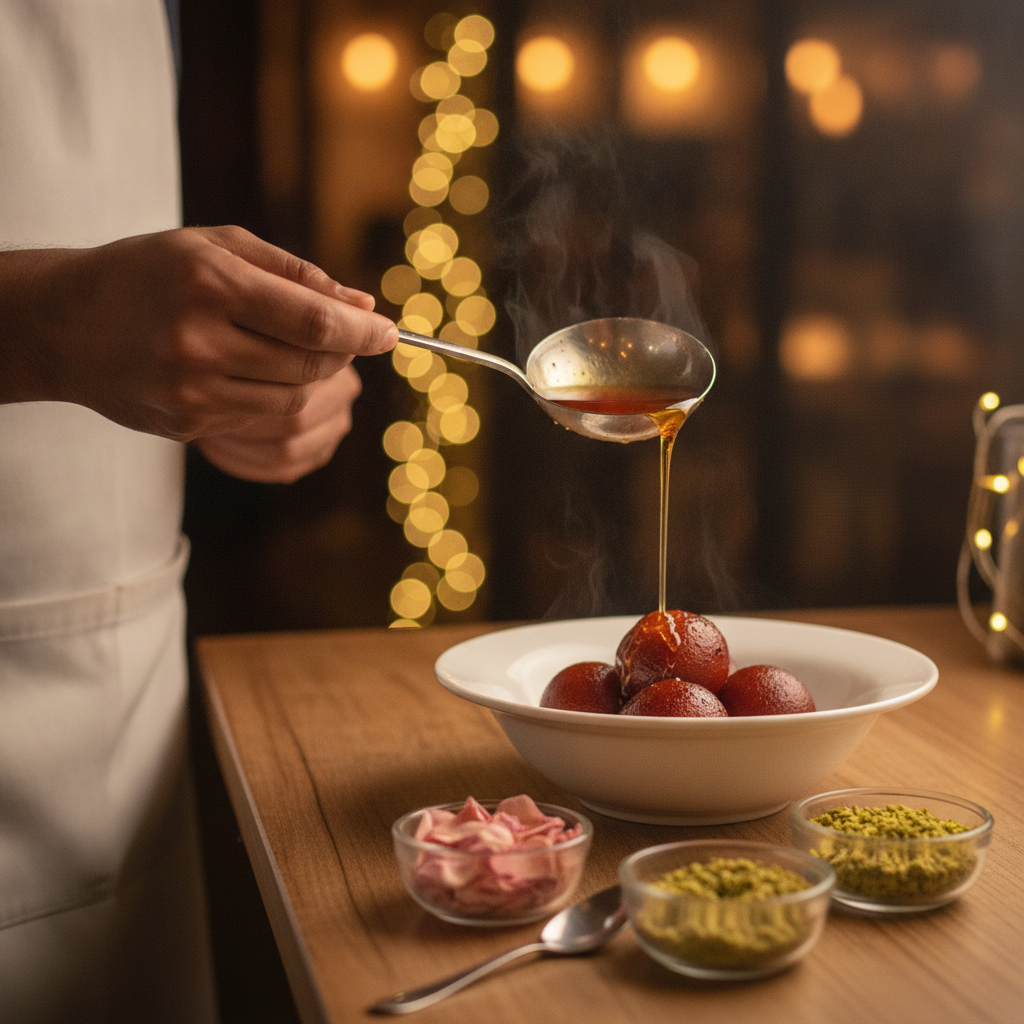
Soak (20–30 minutes)
Transfer to warm syrup. The gulab jamun should be fully submerged. Gently swirl at 10 minutes for even diffusion. -
Finish (serve warm)
Garnish with crushed pistachios. Optionally add a spoon of rabri for extra richness.
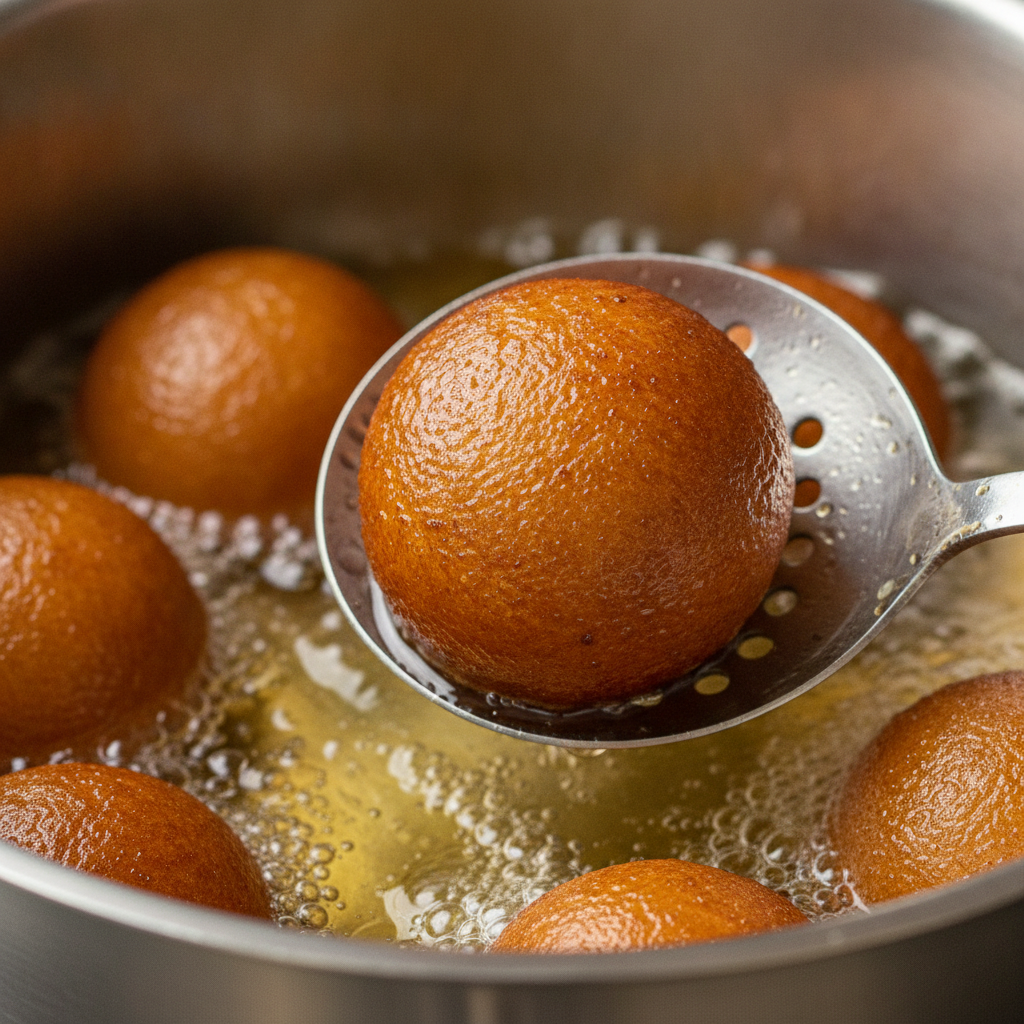
Target checkpoints: Dough yields 24–28 pieces at 20–22 g each; oil recovery between batches should return to 310–325°F in 90–120 seconds; finished pieces expand ~20–30% after soaking.
Best Practices and Troubleshooting
Keep oil between 310–325°F, roll crack-free balls, and soak while both gulab jamun and syrup are warm. Correct dryness with 1–2 teaspoons of milk; fix sogginess by raising oil 5–10°F. Use a 1:1 syrup and rest 20–30 minutes for consistent absorption.
Common issues and quick fixes
- Cracks before frying: Dough too dry. Knead in 1–2 teaspoons milk. Rest 5 minutes and re-roll.
- Dark outside, raw inside: Oil too hot (>340°F). Lower heat; extend fry to 7–8 minutes.
- Dense centers: Over-kneading or too much flour. Next batch: reduce flour by 5 g and mix gently.
- Wrinkled skin after soaking: Syrup too cold. Warm to 140–160°F and resoak 10 minutes.
- Greasy mouthfeel: Oil too cool (<300°F). Increase to 310–325°F; avoid crowding the pot.
Halwai texture checklist
- Finished weight per piece: 24–28 g after soak
- Color: uniform deep amber with no blistered patches
- Soak ratio: 1.5–2x syrup volume relative to jamun volume
- Serving temp: 115–125°F for that classic warm bite
Local considerations for Brampton
- Winter kitchens run cooler; keep syrup closer to 160°F so absorption doesn’t stall during plating.
- Festival weeks get busy; make dough one day ahead (covered and chilled), then bring to room temp 45 minutes before frying.
- Hosting a party? Batch-fry, then rewarm soaked pieces gently in a double boiler to 120°F right before guests arrive.
Tools and Resources We Trust
Use a clip-on thermometer, a wide heavy pot, a slotted spoon, and a digital scale. Precision tools remove guesswork: hold oil at 310–325°F, weigh dough into 20–22 g pieces, and track syrup at 140–160°F for perfect absorption and even texture every time.
- Thermometer: Keeps oil heat stable, which maintains color and crumb.
- Digital scale: Weigh sugar and water 1:1; portion dough evenly for uniform frying.
- Wide kadai or pot: Encourages steady convection so balls rotate and brown evenly.
- Fine mesh skimmer: Lifts gently without tearing the crust.
For fine-tuning syrup viscosity and spice levels, our kitchen walkthrough in the syrup consistency guide gives time–temperature notes you can replicate at home.
Case Studies and Real-World Examples
Our Brampton team applies the same halwai controls at scale: portioning to 20–22 g, holding oil at 312–320°F, and soaking for 25 minutes. These controls keep festival orders consistent and ensure wedding platters have uniformly soft, evenly colored gulab jamun.
- Diwali rush, family platter: We pre-warmed syrup to 158°F and rotated 10-piece batches every 90 seconds. Results: even amber color, zero cracked shells across 120 pieces.
- Wedding dessert bar: For live stations, we used small induction woks set to 315°F and cycled soaking trays at 150°F. Results: steady sheen and 25–30% volume gain after soak.
- Fusion dessert: Guests loved a plated duo with rabri and pistachio dust; if you enjoy twists, explore our in-house take in gulab jamun cheesecake.
Planning a larger celebration? Browsing regional dessert-station ideas can spark inspiration for your event flow; for example, see a local venue’s dessert concepts at the rabdi & jalebi station gallery for service layout ideas.
For daily convenience menus around the GTA, Punjabi tiffin roundups like this Punjabi tiffin services page show how hosts balance hearty mains with a mithai finisher like gulab jamun.
If you’re curious about the craft behind shop interiors that present mithai elegantly, browse a local case profile like Makkar Bakers millwork to see how display lighting and warm metals enhance syrupy sweets on the counter.
Want to taste our benchmark? Drop by or explore our gulab jamun page to see how we present classic Punjabi sweets for gifting and celebrations.
Hosting in Brampton? Our kitchen prepares gulab jamun fresh for gifting and events. Pair with chaat, thalis, and beverages for a complete vegetarian spread. Explore our classic pieces on the gulab jamun product page and ask our team about wedding boxes.
Frequently Asked Questions
The most common gulab jamun questions revolve around dough moisture, oil temperature, and syrup density. Aim for a soft, crack-free dough, fry at 310–325°F for 6–8 minutes, and soak 20–30 minutes in 1:1 syrup at 140–160°F. These three controls solve most texture issues.
How do I stop gulab jamun from cracking while frying?
Cracks signal a dry dough or over-kneading. Add 1–2 teaspoons of milk, rest 5 minutes, and re-roll until smooth. Keep oil at 310–325°F and rotate pieces constantly so expansion stays even and the crust doesn’t split.
What syrup thickness is best for soaking?
Use a 1:1 sugar-to-water syrup by weight. Simmer 6–8 minutes to 215–219°F, then hold syrup at 140–160°F while soaking. This density and temperature allow steady absorption without making the crust soggy.
Can I make gulab jamun without khoya?
Yes. Milk powder yields excellent results with careful hydration, and paneer creates a fresh-dairy profile. Follow the same heat window and soaking rules, and portion dough to 20–22 g for even frying.
How far in advance can I prepare them for a party?
Fry and soak the same day for best texture. For make-ahead, shape dough balls up to a day earlier and chill covered. Bring to room temperature 45 minutes before frying, then soak and serve warm at 115–125°F.
Conclusion and Next Steps
Master the trio of controls, dough moisture, frying temperature, and warm 1:1 syrup and you’ll produce soft, evenly soaked gulab jamun from scratch every time. Use precise tools, portion consistently, and serve warm for that unmistakable halwai-style bite.
- Keep oil at 310–325°F and syrup at 140–160°F.
- Portion 20–22 g dough balls for even cooking and soaking.
- Soak 20–30 minutes; don’t rush diffusion.
- Practice small batches and keep notes on times and temperatures.
Ready for a taste benchmark or a celebration box? Visit us in Brampton or explore our gulab jamun offering. For more technique detail, read our traditional preparation guide and the deep-dive Brampton sweets overview.